


How can we help students become more entrepreneurial by inviting them to take meaningful action rather than simply teaching them theory? In this book chapter, I present 16 concrete action-reflection challenges developed and tested over ten years together with around 350 entrepreneurship students at Chalmers University of Technology. Using the research methodology Designed Action Sampling (DAS), we analyzed 754 student reflections to understand which actions lead to which learning outcomes, and why. The result is an attempt to move from EntreComp, the European Commission’s framework for entrepreneurial competencies, to EntreAct – a framework for what people can actually do to develop these competencies. The chapter also explores how similar challenges can be designed, tested, and validated in other educational contexts.
Abstract:
Sixteen action-reflection challenges around external stakeholder interaction were co-designed, developed and validated over a decade in close collaboration with around 350 entrepreneurship students at a venture creation-based entrepreneurship program at Chalmers University of Technology in Sweden. A novel research methodology termed Designed Action Sampling (DAS) was used alongside a digital reflection tool, resulting in capture of 754 qualitative student reflections and associated quantifications. This allowed for validating the effectiveness of these challenges in developing students’ entrepreneurial competencies.
Challenges were categorized into four groups: Ideas, Resources, Actions, and Emotions. Each challenge was described using a CIMO-logic (Context, Intervention, Mechanisms, Outcomes), providing insights on a micro level into implementation patterns and effects on student learning. Taken together, these challenges represent a framework that links actions to competencies, providing an answer to the question: “Learning-by-doing-what?”. Such a framework is here termed an EntreAct framework, representing a further development of the well-known EntreComp framework of entrepreneurial competencies, previously developed by the European Commission.Findings demonstrate the importance of emotionally charged experiences in entrepreneurial learning and the value of external stakeholder interactions. A generic model for how to design EntreAct challenges is proposed, potentially serving as a starting point for a community of practice among entrepreneurship educators using the DAS methodology to build context-dependent and empirically validated EntreAct frameworks for e.g. nursing, theology or pedagogy.
This research contributes to bridging the gap between entrepreneurial competencies (EntreComp) and actionable teaching practices (EntreAct), offering educators empirically validated tools for fostering entrepreneurial competencies in diverse educational settings.
(Above is the abstract for this text. It is a a full “green open access” version of my book chapter in Derre and Baggen’s book “Empowering the Next Generation of Entrepreneurial Change Agents, available for purchase at Springer. Full text follows below. The original text can be viewed here: https://link.springer.com/chapter/10.1007/978-3-031-82251-3_8 All action tasks presented in this book chapter are available in their full form here: https://app.loopme.io/library/packages/view/6a86c261f854a7337620f04c Finally, a printer friendly version of this text can be downloaded here: From EntreComp to EntreAct book chapter)
Introduction
Design science has a strong inherent ability to bridge between theory and practice (Romme, 2003; Van Aken & Romme, 2009). For entrepreneurship educators, this ability can be used to invent, design and try out new teaching practices to be used in real-world situations with students. The starting point could be more or less theoretical notions about how people might become more entrepreneurial. Design science then helps us reach the much-needed state of detailed articulations of practical teaching techniques, or design principles, for how to succeed with our educational mission in entrepreneurship education (EE).
I have for many years used design science in my own entrepreneurship teaching. In this chapter, I will report from a ten-year journey of crafting and testing various design principles together with my entrepreneurship students at the School of Entrepreneurship at Chalmers University of Technology in Sweden. I label the result EntreAct, since the 16 action-tasks presented here represent a link between entrepreneurial actions (here labeled EntreAct) and entrepreneurial competencies (often labeled EntreComp; a framework for entrepreneurial competencies designed by the European Commission). I have in my previous writing (e.g. Lackéus, 2020c) described rather general answers to a crucial question in EE: Learning-by-doing-what? Here I want to be more detailed. What can we invite our students to do, on a more practical level of taking action, in order for them to become more entrepreneurial? This represents a departure from philosophical and generic design principles such as ideation, business planning, venture creation or value creation. General guidelines are still needed, but the practical nitty-gritty level of everyday techniques may be a more useful starting point for many teachers.
How it all started a decade ago
I worked according to design science principles long before I learned about design science. Apprenticeship teachers in Uddevalla put me on this useful path. Back in 2014, they wanted to use my digital smartphone application for reflection data I had started to develop two years earlier. It is called Loopme, and I have used it for a decade to collect written reflections from my students (see Lackéus, 2014, 2020a). These apprenticeship teachers found my digital approach interesting, but told me that it was not enough to merely collect emotionally charged free reflections from students, which was my approach at the time. An action-task function was also needed that specifies for students what they should first do and then reflect upon afterwards. This helped complete the action-reflection cycle of experiential learning (Kolb, 1984).
We subsequently instructed our programmers to build such a function into Loopme. The technical development of it was the easy part. It was the non-tech part that really confused us. What now to ask students to do in order to learn? We spent a decade testing a broad array of action-tasks on around 350 students in entrepreneurship at Chalmers. It is the result of this decade-long trial-and-error process that I will be reporting from here. The student reflections we received on various attempts to prescribe entrepreneurial action made it clear to us that many action-tasks did not work out as we had hoped for. Some worked quite well, and a select few action-tasks made wonders to our students’ learning journeys. These precious validated action-tasks represent novel and useful answers to the learning-by-doing-what question.
Methodology: designed action sampling
The methodological process behind this work, and its relation to design science, has been described elsewhere under the label Designed Action Sampling (Lackéus & Sävetun, 2023). I will only very briefly describe the process here. From 2014 to 2024 we followed five steps each year: (1) First we (re)designed a set of around 5-30 mandatory action-tasks that our 35 students were to be given in the beginning of the second year of their Master’s Programme in Entrepreneurship and Business Design. This is their final year when they are all expected to work in teams of 2-3 students to start a real-life tech venture based on someone else’s idea. Two thirds of each class start a new independent venture, and one third starts an internal venture in a large firm, i.e. intrapreneurship. (2) In August each year the students were introduced to the action-tasks, and subsequently took action. They were given from September to April to do up to ten action-tasks. (3) After each action-task was completed, they submitted digitally to us a short written reflection around what they did, how it went, and what they learned from it. They also quantified their emotional experience and their learnings according to the EntreComp model of entrepreneurial competencies (Bacigalupo et al., 2016). (4) We analysed their reflections and quantifications continually, and discussed a synthesis of them with the students twice per year. Students were invited to reflect upon how the action-tasks worked for them, also as a collective of tasks. (5) In the final step, insights were summarized and fed into a new design iteration, thus going back to step 1 again the following year. Each year the collection of action-tasks was thus redesigned, evolving organically based on reflections, quantifications and collective analysis. Some years modifications were more major than other years. The complete collection of discarded and currently active action-tasks can be seen at library.loopme.io. Here we will focus on the 16 most interesting and powerful action-tasks that we ended up with. These 16 action-tasks have been largely unchanged for the last three years, resulting in 754 reflections from 105 students on them, see Figure 1.
The 16 action-tasks are presented in four groups of four, based on which quantified effects they resulted in according to the students who tried them out in practice. Three of these groups – Ideas, Resources and Action – are aligned with the EntreComp definition of entrepreneurship competence as “the ability to transform ideas and opportunities into action by mobilising resources” (Bacigalupo et al., 2016, p.10, my added emphasis). A fourth group – Emotions – purports to capture some additional emotional effects. This was to make sure that the crucial role of emotions for entrepreneurial learning was not lost here (cf. Lackéus, 2013). Each student also had to quantify their emotional experience on a likert scale, see “Emotion average” in Figure 1 which spans from -2 (very negative) to +2 (very positive) (cf. Lackéus & Sävetun, 2023). I used quantitative data from 2021-24 to determine which of the action-tasks that were the most powerful and interesting ones. I then picked 16 action-tasks that as a collective had been shown to result in a broad set of developed entrepreneurial competencies. I first aimed for ten action-tasks, but to cover all competencies in EntreComp I needed to expand to 16 action-tasks.
Please keep in mind the limitation that stems from design principles being contextual (Romme & Dimov, 2021). The action-tasks were developed in a highly experiential and emotional full-venture creation programme environment (Smith et al., 2022) where students get one full year to start a real-world high-technology independent or internal venture based on someone else’s idea (see further in Lundqvist & Williams Middleton, 2024). Transferability of these action-tasks to other learning environments may thus vary. We also need to carefully take pragmatism into account, which stipulates that the question “What works?” should perhaps be replaced by “What works for whom, in what circumstances and why?” (Biesta & Burbules, 2003; Brentnall, 2023).
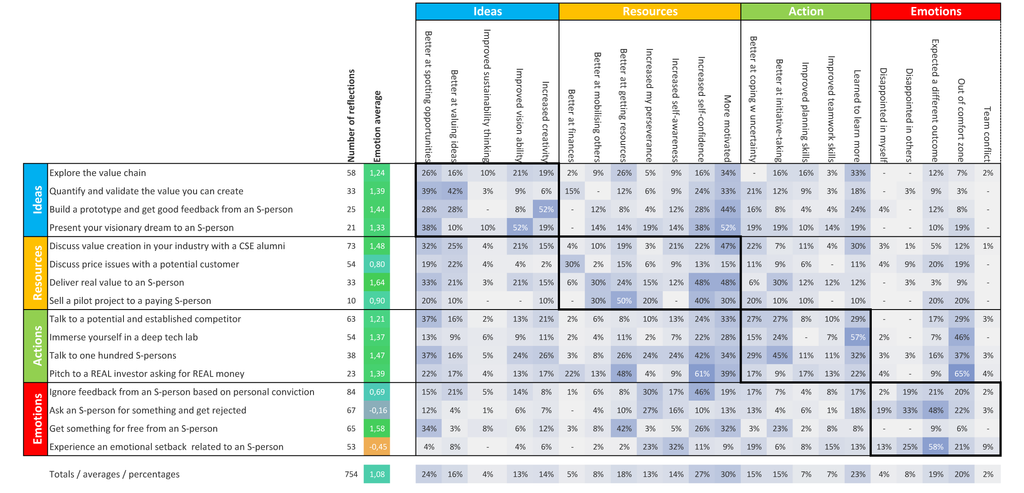
Figure 1. The 16 action-tasks (left), the resulting emotional average per task and the resulting quantifications provided by 105 students during three academic years 2021-24. Percentages represent the share of reflections upon an action-task that were tagged with the corresponding labels (top). Students could choose to associate one or many of the labels to each reflection.
The 16 action-reflection challenges
I will now describe the 16 most interesting and powerful action-tasks among all the ones that we have designed and tried out over a decade. For my students I label them action-reflection challenges. They are all focused on external stakeholder interaction, or “s-person” interaction which I call it. To focus only on external stakeholder interaction was a decision made in 2021, after having observed that it was the student interaction with external stakeholders that triggered the most interesting reflections and the deepest learning each year. This is how I introduce these challenges to new students each year:
“You will be given a choice of 10 challenges among 30 possible interactions with so called S-persons – a Significant Stakeholder relevant to your venture but NOT part of your venture or emotional owner to your venture (i.e. NOT your idea partner, other close partner, funder, sponsor, internal coach, corporate coach, teammate, etc). We meet once in the autumn and once in the spring to discuss your reflections, to see what you learned, in a collective analysis.”
For each challenge comes first a verbatim description of it, the way it is presented to the students. Then follows a design science inspired description, based on CIMO-logic (Denyer et al., 2008), where C stands for context, I stands for intervention, M stands for mechanisms and O stands for outcome(s). Context is always the same here – a venture creation programme in entrepreneurship. Therefore, only I, M and O are described for each action-task below, based primarily on an analysis of the 754 qualitative student reflections, consisting of 141 000 words. For each group of challenges, I also introduce the group briefly. Each challenge description starts with “prove to me…”, emphasising that I always expect students to first give a comprehensive and convincing enough description of what they did. This is to lower the risk that students just pretend to have acted by writing a “zombie reflection” (De La Croix & Veen, 2018). Reflections are not graded but assessed through emotion-laden activity-based assessment in a pass-fail manner (Lackéus, 2022; Lackéus & Williams Middleton, 2018).
Developing “Ideas and opportunities” skills
Ideas skills can be developed by asking students to explore, dream, prototype and quantify the future value they might one day be able to contribute with. Doing this together with external stakeholders seems to help them develop their ability to see in a more creative way a future where they become a novel part of an established value chain in society. The challenges in this group all illustrate how deeply relational the entrepreneurial job is, especially in the first stages of ideation.
1. Explore the value chain
“Prove to me that you discussed and communicated value for others by discussing with an S-person who is NOT a potential customer but instead a representative of a value chain your project needs to become a part of in the future. Reflect here on how it felt, what you learned from it and how you will do next time around.”
Intervention. Many students explored value chains through conversations with suppliers, experts, seniors and customers’ customers, discussing for example how an industry creates value, how it struggles in various structural ways, and how things actually work beneath the surface. Since discussions were held with non-customers, it was often more open and less filtered than a typical customer discussion. It was a good way for students to start learning about a new industry.
Outcomes. This challenge often triggered a deeper overall understanding of the industry that students were attempting to enter. Many students reported that they learned how to scope their venture, who to create value for, who to initiate strategic collaborations with, how to structure a deal and which industry problems to try to solve. It also sometimes led to improved sustainability thinking (see Figure 1), perhaps due to an emphasis on structural value creation and problems.
Mechanisms. Having a non-customer value chain focus seems to help students zoom out and take a more overarching and strategic perspective than the more typical customer interview.
2. Quantify and validate the value you can create
“Prove to me that you analyzed for value creation by quantifying the benefit your solution has to potential customers, and getting this validated in discussions with an S-person who is also a potential customer. Reflect here on how it felt, what you learned from it and how this impacts your project.”
Intervention. Many students sat down with various potential customers to co-analyse, co-validate, co-quantify and even co-create an interesting business case for them. Together they did the math and quantified the value that might be created, be it in terms of cost savings, time saved, increased quality or some other value such as societal or enjoyment value. This was then often related to the customer’s internal Key Performance Indicators (KPIs) or other industry relevant quantitative benchmarks. Some customers then became interested in paying for a pilot test.
Outcomes. Many students got an early glimpse of real-world commercial negotiations and then learned how to develop customer empathy, insight and understanding. This was a positive experience where they gained skills in spotting opportunities and valuing ideas, see Figure 1.
Mechanisms. Quantification is a classic method of building trust (Porter, 1996). This could perhaps explain why asking students to quantify value together with potential customers may be an effective way to learn collaborative idea development skills in practice.
3. Build a prototype and get good feedback from an S-person
“Prove to me that you created value for others by building a prototype and getting good feedback on it from an S-person. Reflect here on how it felt, what you learned from it and how you will do next time around.”
Intervention. Many students worked creatively to build a minimum viable product (MVP). The most tangible prototypes were built in the IT sector, e.g. mockups, wireframes or fully working user interfaces. Also outside IT, many students created prototypes, e.g physical devices, flow sheets, process diagrams, folders, models, videos or other kinds of graphical visualisations. A prototype often triggered concrete and engaged discussions with external stakeholders. Sometimes it also helped students convey a powerful future vision for the industry.
Outcomes. Many students learned how to solicit really powerful and sometimes even painful customer feedback. Some students also learned about relationship-building through co-creative prototyping, thus creating buy-in and winning precious ambassadors for their vision. This challenge clearly developed many students’ creativity, see Figure 1.
Mechanisms. Concrete visualisations activate our brain’s imagination more than abstract talk (Blakemore & Frith, 2005; Mulligan, 1993). Such activation through prototyping seems to foster both students’ creative engagement and increase the quality of many customer dialogues.
4. Present your visionary dream to an S-person
“Prove to me that you envisioned something really new by presenting your visionary unreasonable artistic dream idea on how to do something really novel and unique in your area, and getting an S-person in your industry to still like it. Reflect here on how it felt, what you learned from it and how you will do next time around.”
Intervention. Many students really pushed themselves here and dared to present a visionary and bold future dream that could potentially revolutionize an entire industry, to experts within that very industry. Some students remarked that such a fluffy, unrealistic and perhaps even unreasonable dream needed to be backed up by data and facts. Others saw the need for a truly personal and genuine tone that conveys likeability. Many were surprised at how well a visionary dream was received by many experts.
Outcomes. These students got to practice and hone an important kind of visionary sales skill. They learned that visionary talk can help identify and attract likeminded innovators and early adopters amid larger crowds of people. They also learned the importance of having and nurturing a visionary dream, both for their own motivation as entrepreneurs and for early adopters and co-creators who become keen to share their enthusiasm.
Mechanisms. Playwright George Bernard Shaw once wrote that all progress depends upon unreasonable people who refuse to adapt to the world, but instead try to adapt the world to their visionary future dream (Elkington & Hartigan, 2008). This challenge uniquely shows how we can teach such a deviant skill. But we also need to keep context in mind. The 21 students who completed this challenge had been entrusted with someone else’s quite mature high-tech idea to play around with. Can students who work with their own much less interesting ideas (cf. Jones & Penaluna, 2013, p.807) even be given this challenge?
Developing “Mobilising resources” skills
There seems to be many different ways to work effectively with resource skills. An easy start is to let students discuss with alumni from the same entrepreneurship programme. However, stronger development of resource skills instead comes from delivering real tangible value to someone else, in the form of a pilot project or in some other form. Finance skills is an outlier here, but can for example be developed by asking students to discuss price issues with potential customers.
5. Discuss value creation in your industry with an alumni
“Prove to me that you analyzed for value creation by contacting an alumni from our program, asking for a meeting to discuss value creation in your industry. After the meeting, reflect here on how it felt, what you learned from it and implications for your project.”
Intervention. Discussing one’s entrepreneurial project with a friendly, helpful and experienced alumni from the same programme was emotionally comforting and boosting. Most students picked an alumni with work experience from the same industry or technology area. Topics varied greatly, e.g. early sales work, intellectual property, equity distribution, teamwork issues, networking, customer insights, etc. Many discussions centred around how to create value in their industry or with their type of technology.
Outcomes. Many students ended up more motivated and confident, less insecure and more able to cope with the uncertainty of an early stage project. Many alumni gave the advice to avoid getting stuck in analysis, and prioritise going out and talking to people (cf. Blank & Dorf, 2012; Brinckmann et al., 2010). The meeting often became the starting point of a very rewarding and trustful mentorship relation. Many students saw the meeting as a good example of effectuation, in terms of leveraging one’s network to acquire a key resource for free (advice and mentoring).
Mechanisms. The fundamental mechanism here seems to be alumni mentorship. An alumni mentor can offer crucial emotional and motivational support based on high contextual understanding, but also practical tips that are specific to the industry or technology in question.
6. Discuss price issues with a potential customer
“Prove to me that you explored pricing issues by discussing price issues with a potential customer. Reflect here on how it felt, what you learned from it and how you will do next time around.”
Intervention. This challenge had a much wider variation in emotionality than the average challenge. Money talk can be both emotional and arbitrary in terms of customer reactions. Some customer are price sensitive, others may downplay the cost. Many students ended up in price discussions that at first felt uncomfortable, but then ended up touching upon many key issues such as pricing strategy, production costs, competitor offerings and potential pilot tests. Some even ended up in real negotiations and made real deals, then reflecting that a customer willing to talk money is a really interested customer.
Outcomes. Many students learned that it is more natural for people to talk about money than they had expected. A common conclusion was that one should not be afraid to have price discussions, even if it is still unclear what solution you offer or what problem you solve. It triggers a lot of important learning around the market, and also highlights a need for financial and cost planning.
Mechanisms. Money is the most prominent resource in modern societies, so talking about it is a crucial skill to develop. This also allows for truly emotional and thus powerful learning (cf. Boekaerts, 2010). Students learn about their offering, their market, the alternatives, and also about themselves.
7. Deliver real value to an S-person
“Prove to me that you created value for others by delivering real value to an S-person at least once and in a non-scaleable way. Reflect here on how it felt, what you learned from it and how you will do next time around.”
Intervention. Given the technical complexity of projects at this Master’s programme, most real value deliveries were in the form of epistemic value. Examples included collecting interesting data, analysing new markets, conducting customer interviews, educating people around novel technology, and presenting their project in front of people who then gained new insights. A few prototypes were also mentioned, such as a team baking dog food for real “S-dogs” using food waste. Many teams also delivered real value outside their own project scope to gain goodwill, expand their network or win ambassadors. This was a values trading that often ended well.
Outcomes. Many students reported about a strong boost in motivation and confidence, claiming that they learned to believe in their work and ability to create real value. Some saw it as a practical experience of open innovation where SMEs help each other to develop a novel field. Many learned how useful it is to help others, since they give back. This was especially the case for intrapreneurs who are embedded in a large hierarchy. The skill to mobilise others was clearly developed here.
Mechanisms. The many positive emotions and desirable effects of various others-focused activities seen here are good examples of prosocial motivation theory at work (Batson et al., 2008; Miller et al., 2012). We humans often find a deep sense of meaning in collective activity.
8. Sell a pilot project to a paying S-person
“Prove to me that you created value for others by selling a pilot project to a paying S-person, before you even built a product / service, in a “Sell First Build Later” (SFBL) way. Reflect here on how it felt, what you learned from it and how you will do next time around.”
Intervention. This challenge was very difficult, and was thus reflected upon only by one or two teams each year. Most of them got a paid pilot project up and running, and a few reported from their failed attempts. In all cases, students ended up in real negotiations involving real money in the range of 5-10.000 EUR. To succeed, the team needed to tick many boxes. Finding someone who had a problem important enough to be solved, who liked their vision around proposed value to be created, who could get a budget approved, and who was willing to spend it on an unproven student team. Most if not all pilots also came with significant technology or process uncertainty.
Outcomes. Trying to get a paid pilot project up and running entails many different aspects of being entrepreneurial. It could be one of the most complete challenges in this respect. Students thus reported having developed many different entrepreneurial competencies, such as flexibility, perseverance, courage, skills in sales, visioning, resourcing, negotiation and planning.
Mechanisms. This could be one of the first formalized in-curricular examples of students learning through trying to sell a paid pilot project to a potential customer, in a sell-first-build-later manner. Given the broad set of learning outcomes observed, it represents a promising answer to the learning-by-doing-what question, striking an interesting middle ground between value creation and venture creation.
Developing “Into Action” skills
All four action-tasks that develop action skills in a powerful way are associated to rather intense and deeply personal interactions that require courage, perseverance and initiative. It can be intimidating to talk to a potential competitor, to one hundred people, to a real investor, or to laboratory staff who possess deep knowledge in an industry where oneself is a novice.
9. Talk to a potential and established competitor
“Prove to me that you discussed and communicated value to others by discussing your project with a potential and established competitor. Reflect here on how it felt, what you learned from it and how you will do next time around.”
Intervention. Discussing with a potential market opponent is frightening for many reasons. Revealing your own tech secrets, annoying others through sneaky questions about their tech or market secrets, breaching the NDA of your corporate partner if you are an intrapreneur, becoming demotivated by the superiority of your future rival. However, most students were pleasantly surprised by the friendliness they were greeted with. Many competitors openly shared their experiences and insights, and were often truly interested in partnering to deliver on the same societal goal, sometimes in a coopetition manner.
Outcomes. Many students learned to be more open-minded, curious and relational when meeting people initially perceived as a threat. They often gained crucial insights about the industry, the market, trends, potential differentiators and challenges. Learning about others’ hard-earned facts gained through trying to solve similar problems can be helpful in a truly unique way. Many also reported being motivated by competition, seeing it as a sign of a genuine market need. Ethical skills were at times developed, since many students played the “student card” in an “undercover” way to make competitors reveal their secrets, which for many felt really awkward. They then advised others to be more open with their intentions. Honesty works fine too.
Mechanisms. This challenge exposed some key differences between competing and collaborating, thus representing a concrete way to refocus EE more on co-creation (cf. Watson & McGowan, 2020). Many students assume that entrepreneurship is all about competing, and here learn that novel solutions to vexing issues are often developed through effectuation-based collaboration.
10. Immerse yourself in a deep tech lab
“Prove to me that you had courage by immersing yourself in a deep tech lab and discussing your project with at least one S-person in the lab, even if you don’t know the tech so well. Reflect here on how it felt, what you learned from it and how you will do next time around.”
Intervention. Many students engaged in humbling and exciting conversations with researchers, specialists and other experts at the forefront of a technological field. It could be in a deep tech academic lab, in a corporate technical development department or in a factory. It became a concrete illustration of key principles such as effectuation (leveraging the resources present in a lab), learning-by-doing (a concrete and graspable experience triggering powerful reflective observation) and design thinking (becoming an insider feeling empathy with others). This was a scary experience for many students, feeling vulnerable but also empowered by the superior level of detailed knowledge provided. Many students prepared thoroughly through independent study.
Outcomes. Students learned to learn in many different ways. Not only by leaving their own building (cf. Blank & Dorf, 2012), but also by getting inside the right building. They learned to learn from experts by asking powerful questions, by being quiet, by building relationships, by forming interdisciplinary teams, by embracing the uncertainty inherent in experts sharing deep knowledge. Many students saw it as an opportunity for them to become a crucial link between deep technology and commercial markets, between research and practice. This helped build emotional agency for the technical innovation students had been entrusted with. Many were also surprised by how fast they could learn in this way, how well they could cope with complex vocabulary and how valuable it was for them to gain detailed technical knowledge.
Mechanisms. Visiting a deep tech lab helps students conduct a techno-economic value analysis (TEVA), an important step in technology-based intra- and entrepreneurship (Lundqvist & Williams Middleton, 2013). TEVA links detailed technical functionalities to valued customer utilities on the market, mediated by key performance indicators.
11. Talk to one hundred S-persons
“Prove to me that you discussed and communicated value to others by talking to 100 S-persons, be it customers, experts, value chain people, network actors, etc etc. Reflect here on how it felt and what you learned from it.”
Intervention. Many students first thought this was an impossible challenge. But every year, almost half the class proudly reported having reached the goal through phone calls, video meetings and in-person meetings. Some used fairs and networking events, but most meetings were scheduled by painstakingly contacting people relevant to their project. Many used sales funnel and snowball sampling techniques. These conversations helped them understand the industry, emerging trends and customer needs and pain points. They also identified innovators, early adopters and co-creators. Many reported having built up a comprehensive industry network in just nine months. Some claimed having become experts in their niche thanks to these conversations.
Outcomes. Students learned practical techniques for how to make cold contacts and book meetings, how to overcome their fears, how to prepare meetings, how to ask good questions, how to make people excited and how to make them open up to talk about their problems. Many reported going from nervous to confident in early-stage entrepreneurial sales, even loving it. They learned how to decide which meetings to take and which ones to not waste time on. Perseverance was built when realizing that sales is a numbers game where more is always better.
Mechanisms. This was the most appreciated challenge among many students, thanking for this marathon forced upon them, asking us to keep it in the curriculum forever. For many it was really challenging, but also really rewarding for their project and impacting them for life. This challenge arguably captures much of what entrepreneurship is all about. To take action and throw yourself out there, even if your entire body screams NO at times, to then become an extreme learner who loves to see every single human interaction, especially the difficult ones, as a unique learning opportunity (cf. Smilor, 1997, p.344).
12. Pitch to a REAL investor asking for REAL money
“Prove to me that you had courage by pitching to a REAL investor asking for REAL money. Reflect here on how it felt, what you learned from it and how you will do next time around.”
Intervention. This challenge was the most uncomfortable of all, but also the most confidence-building, see Figure 1. The students pitched for funding, either to an investor, to a large audience at a pitching event or to an internal corporate committee or management team. The money they asked for spanned from €5000 to €500.000, with a typical amout being around €30.000. Some got what they asked for, many did not. Key components of their pitch were what value they intended to create, for whom, how this was unique, and which facts supported their claims. Intrapreneurs had the added complexity of aligning their pitch to corporate strategy. After their pitch, students got many different questions, some more challenging than others.
Outcomes. Students explained afterwards that pitching is an experiential skill that requires real-world practice to be developed. They learned the importance of being genuine, showing enthusiasm, managing body language, preparing meticulously, practicing the actual pitch before and managing a broad variety of tricky questions afterwards. They became more confident in speaking to investors. They also learned about many different details to include in a pitch deck.
Mechanisms. Pitching is common in EE, often in front of a jury (Brentnall, 2023). But in this case there is also an aspect of genuinely asking real investors or managers for their money. Each pitch had real-world consequences for their team. This addition could help explain why the effects were so strong in terms of student discomfort, confidence-building and also ability to mobilise resources.
Developing “Emotions” skills
While there is not a specific emotions skill in the EntreComp framework, many entrepreneurial skills such as self-awareness (a resource skill), uncertainty coping (an action skill) and opportunity spotting (an ideas skill) often require emotionally charged experiences to be more profoundly developed (Lackéus, 2020b). Some challenging activites that have been found to trigger deep learning are to ignore other people’s advice, to get rejected or to experience different kinds of emotional setbacks. However, also deeply positive experiences can play an important role here, such as managing to get something useful for free from an external stakeholder.
13. Ignore feedback from an S-person based on personal conviction
“Prove to me that you were dedicated on a personal level by getting feedback from an S-person in your industry, later to ignore that feedback to instead do what YOU believe is the right way forward. Reflect here on how it felt, what you learned from it and how you will do next time around.”
Intervention. This was the most common challenge, see Figure 1. Many students wrote that they ignored feedback all the time, such as if their entire project idea was blasted by an industry expert. Many were still nervous, fearing damaged relationships to key people. The ignored feedback was often deemed to be biased, diverging, out of context, guesswork, outdated or simply at odds with the students’ vision. Feedbackers could be innovation killers, overconfident know-it-all’s, uninformed laggards, blatant promoters of their own niche or representatives of old ways of doing things. Potential customers were often deemed to be wrong or asking for things they would not pay for. Some intrapreneurs also took the risk to ignore internal supervisors, managers, gatekeepers or entire established corporate truths or cultures.
Outcomes. Ignoring bad advice often developed grit and perseverance. Many proudly reported gaining the courage and confidence to stick to their vision, to trust their instincts and to listen to their gut feeling. But they also saw negative feedback as a learning opportunity and a way to practice a delicate balancing act between not giving up and knowing when to pivot. If negative feedback dominated, some saw the very few positive people as a sign that change is indeed needed. They then tried to turn these few likeminded early adopters into co-creators of radical innovation. Some students learned to manage their own inner negative thoughts, not losing their faith but instead going their own way to gather their own facts and proof. This filled them with a strong sense of ownership.
Mechanisms. Most people are not innovators or early adopters (Moore, 1999), so it is quite natural for students to meet many late adopters and laggards who are less able to give relevant feedback. Also, customers cannot be fully trusted to know what they actually want. This has been called the “faster horses” problem, after Henry Ford who was known for paying less attention to customers: “If I had asked them what they wanted, they would have said faster horses” (Gordon et al., 2019).
14. Ask an S-person for something and get rejected
“Prove to me that you experimented by asking an S-person for something significant to your project (not just a meeting), and getting a clear no from this person, i.e. get rejected. Reflect here on how it felt, what you learned from it and how you will do next time around.”
Intervention. The most common reason for rejection was when students tried to initiate collaboration with a potential customer. It could be to ask for a pilot project or a letter of intent. Other rejection examples were students asking for sensitive data, expert advice or help, a study visit at a factory or free access to a database, industry report or lab. Some rejections were about tangible resources such as funds, grants or products. Rejections made students feel sad, frustrated, disappointed and demotivated, see Figure 1. But it also made them reflect on the importance of perseverance, trying harder next time and eventually feeling the strong motivational power of overcoming challenges.
Outcomes. Many learning outcomes were related to sales strategy. Tactical sales insights around how to make new contacts, how to prepare and carry out effective sales meetings and how to negotiate a deal. Strategic sales insights around how to build a sales pipeline, the importance of measuring progress, who to approach at what stage and why an industry network is a crucial tool. Many key insights were also emotional and relational. Students learned how to master the art of coping with and even planning for failure, seeing it as a natural road to success instead of taking it personal. They also learned the importance of a positive growth mindset and building strong trustful relationships.
Mechanisms. This challenge lets students practice a crucial entrepreneurial skill – rejection management. Early-stage entrepreneurial sales is often counter-intuitive in that the frequency of rejection is shockingly high. Most inexperienced people who get rejected by 90% or more would trust their gut feeling to give up. But when bringing novel and complex solutions to the world, initial rejection must be expected. This is described in sales and innovation literature (e.g. Rackham, 1989; Rogers, 1983), but needs to be learned viscerally.
15. Get something tangible for free from an S-person
“Prove to me that you took emotional action by getting something tangible – an object, a resource, a gift of some kind – you needed for your project from an S-person in your industry, just because you showed this person that you care so much about your project. Reflect here on how it felt, what you learned from it and how you will do next time around.”
Intervention. A broad range of tangible and useful gifts were given to those students who took emotional action by demonstrating their passion and personal dedication to key S-persons. Students received free entrance to expensive fairs, to exclusive events and to influential committees. After trust and common interests had been established, they were sent confidential and useful documents and data of many different kinds, as well as valuable hard-to-find contacts. Also products and raw materials were given away to them, such as stoves, cameras, laptops, scooters, door locks, swimwear, whey, metals and chemicals. Some students were even granted free office space and free exhibition space worth upwards of €2.000.
Outcomes. This challenge was the easiest and most common way to develop students’ ability to acquire resources, see Figure 1. Students learned to connect emotionally by showing engagement, passion and vision, as well as by being nice, empathetic, and thankful. They learned that many people want to help when sympathy, relational trust and reciprocity are present. Many students saw this as a way to practice effectuation principles such as bird-in-hand (leverage your resources such as your network), crazy quilt (co-create with those willing to commit) and the ask (dare to ask for commitments).
Mechanisms. This challenge lets students learn effectuation in a hands-on way. It also gives them insight into powerful mechanisms portrayed in Marcel Mauss’ famous anthropological gift theory, stipulating that gifts are deeply relational (Graeber, 2001). Gifts carry a special power to nourish deep relationships by being personal, even spiritual, and by creating desire to reciprocate.
16. Experience an emotional setback related to an S-person
“Prove to me that you revised by experiencing an emotionally charged setback involving an S-person. Reflect here on how it felt, what you learned from it and how you will do next time around.”
Intervention. Most emotional setbacks occurred during meetings with potential customers who bluntly blasted the students as ignorant time-wasters, overly optimistic or less unique than claimed. A few setbacks were about embarrassing demo failures, final rejections in pilot negotiations, being ghosted by customers amid positive talks, getting a very low response rate (<10%) on attempts to reach out to many, and late cancellations. Other setbacks were more personal, such as realizing one’s lack of passion for the venture, realizing a bad choice of customer segment or experiencing major collaboration issues in the team. Finally, a few really emotional setbacks were about project termination due to consistently negative feedback from customers or betrayals within the team.
Outcome. Many students were baffled by how deeply affected they were by an emotional roller-coaster, at times experiencing shock, shame, grief, hopelessness and self-doubt. While they learned to see failures as creativity-sparking learning opportunities, they also learned the perils of being naïve. Don’t trust everyone, prepare yourself meticulously, do your own checks and try to spot early warning signs. A common theme was the crucial role of emotional intelligence and resilience, managing expectations better, not taking things too personal or becoming defensive, but instead staying flexible and open-minded, using new insights to revise and try again and again. Teamwork insights were triggered by seeing how important the team is when coping with difficulties, highlighting the need for transparent team communication, honesty and trust.
Mechanisms. This challenge captured the naturally occurring crisis-triggered entrepreneurial learning events among these students (cf. Cope & Watts, 2000). Critical learning events are crucial to how entrepreneurs and intrapreneurs learn, and should thus be monitored in experiential EE. Teachers can use these events for pedagogical purposes as they unfold, to show the entire class what can happen and what insights can be drawn from such crises.
Discussion
The complex beauty of emotionally charged intra- and entrepreneurship
Re-reading the 754 student reflections analysed here has been a true joy. They illustrate the sheer beauty of the entrepreneurial lifestyle, where exhilarating moments of success and insight are mixed with life-impacting crises. Being entrepreneurial is a rollercoaster that truly makes life worth living for some people, but also makes other people search for a different and much calmer career. Analysing the outcomes of these action-tasks has at times been surprising. Many unexpected links surfaced, such as between non-customer talks and sustainability thinking, between alumni mentors and resource acquisition skills, and between deep tech lab visits and learning to learn.
What was not surprising to me, however, was to see how omnipresent and important emotions were in these student reflections. Entrepreneurship is deeply emotional labor (cf. Hochschild, 1983). If we want to understand EE better, we need to focus more on emotion-based impact indicators (Nabi et al., 2017). Figure 1 highlights a weak point of EntreComp as an outcome assessment framework in EE. If emotionality had been absent here, key entrepreneurial outcomes would have been invisible, such as ability to cope with rejections, setbacks, bad advice, disappointments and missed expectations. What is also made visible is that external interaction is a very positive and motivation-triggering experience in most cases.
Figure 1 shows that two competencies stand out in relation to negative emotions; perseverance and self-awareness. Many student reflections illustrate how important negative experiences are for building these crucial competencies. However, deliberately triggering negative emotions in students has ethical and practical implications for teachers. Can we allow ourselves to inflict emotional pain on our students? How will it impact other kinds of learning? Can we cope with the anger and frustration it triggers? Many people deal with failure through restoration orientation; redirecting their negative emotions towards secondary sources of stress (Schut & Stroebe, 1999). At our programme, we sometimes see students distracting themselves from grief by engaging in conflicts with teachers and other university employees (Blomé & Simson, 2021).
From EntreComp to EntreAct: tactics for entrepreneurial action
EntreComp is a framework for understanding what it means to be entrepreneurial, packaged as 15 different competencies of equal importance (McCallum et al., 2018, p.13-14). But entrepreneurial competencies are evasive and fuzzy. Even if EntreComp helps many teachers by succinctly specifying what entrepreneurial competencies are, the framework gives scant support to teachers around what students can be asked to do in order to develop those competencies. There is a need to establish something we can call EntreAct – a corresponding framework for the doing required to become entrepreneurial (Lackéus & Sävetun, 2023, p.22).
What would an EntreAct framework look like? Will we ever be able to specify 15 generic EntreAct action-tasks of equal importance, in a neat flower model like EntreComp? This is indeed a challenging proposal. The 16 action-tasks described here are only one example of how people can develop EntreComp competencies, taken from the specialized context of a venture creation programme at a university of technology in Sweden.
EE is deeply contextual (Lindahl Thomassen et al., 2020), so one collection of EntreAct action-tasks might not work well in a different setting. Can we ask nursing students, theology students or primary school kids to explore an industry’s value chain or discuss price issues with a competitor? It could make them more confused instead of more entrepreneurial. We therefore need different action-task packages for different contexts. What the 16 action-tasks outlined here can hopefully achieve is inspiration to others when creating their own variation.
A model for designing EntreAct challenges
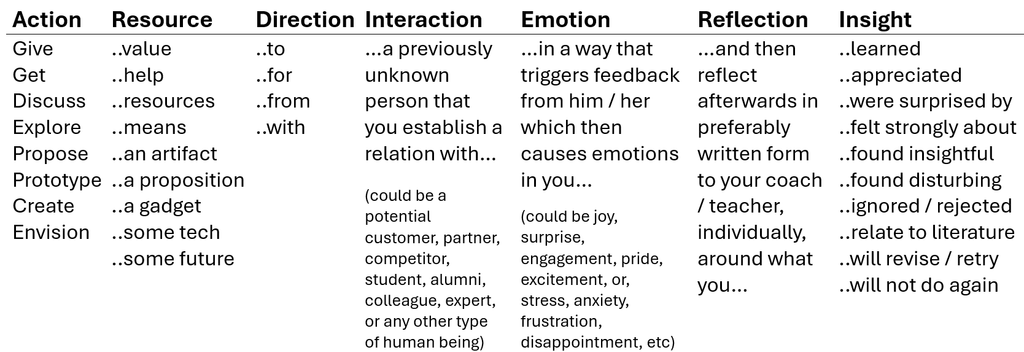
In an effort to further help teachers design action-reflection challenges, Table 1 shows a generalization attempt based on commonalities across the 16 action-tasks. An EntreAct action-task includes taking action centred around a resource, or more generally around value. It specifies at least one of four different directions in an emotion-laden personal interaction with a person previously unknown to the student. It also includes a request to reflect in writing afterwards, both as a way to trigger deep insights and as a time-efficient way for the teacher to assess many students. The last part of the reflection is forward-looking, implying that it is an iterative process of up to hundreds of EntreAct interactions carried out by each student.
Table 1. A generic inspirational model EE teachers may use when designing an action-reflection challenge of EntreAct type. Teachers pick one of eight action types, couple it with one of nine resource types and one of four direction types. This gives them a skeleton they can contextualize further for use with their students.
The overarching logic of EntreAct
Pedagogical advice to EE teachers can according to Mansoori (2018, p.49) be offered on three different levels; (1) practical level of tactics, i.e., tools and techniques, (2) middle level models, and (3) high-level overarching logic. If the 16 action-tasks in Figure 1 represent a set of practical tactics, and Table 1 represents a middle level model, what is then the overarching logic of EntreAct? This is a difficult question to which only provisional answers can be given here. One perspective is that EntreAct guides teachers in how to make their students experience all four aspects of the CAVE framework recently proposed by Sarasvathy (2024). CAVE stands for causal (e.g. hypothesis testing), adaptive (e.g. asking for advice), visionary (e.g. passionate pitching) and effectual (e.g. co-creation) tools and techniques used by entrepreneurs in their resource- and relationship-seeking activities. Together, the 16 action-tasks cover all four CAVE dimensions.
Sarasvathy often argues for the entrepreneurial logic to be taught to everyone, just like the scientific method is regularly being taught to all students (Sarasvathy, 2024, p.24; Sarasvathy & Venkataraman, 2011, p.115). What EntreAct related efforts can contribute with, as well as a design science approach more in general, is to make such an endeavour actionable and reliable for teachers on a practical level of models and tactics. This is helpful in making entrepreneurial competencies broadly accessible to students of all ages and in all faculties, from primary school through high school to university and adult education – from ABC to PhD (Moberg, 2014).
An EntreAct community empowered by DAS methodology
If many EE teachers would start to design EntreAct task packages similar to the one presented here, a strong community might emerge. These teachers could rely on DAS as a design science approach to design, test, validate, discuss and diffuse a large number of EntreAct action-task packages in many different EE contexts. The DAS methodology could help such a community analyse in considerable detail how different EntreAct activities are causally linked to different EntreComp competencies. This could become an antidote to the prevailing McDonaldization of EE, where strikingly similar approaches such as competitions, inspirational lectures, business model canvas workshops and money-making challenges dominate EE (Hytti, 2018).
The 16 challenges presented here do not at all rely on such McDonaldized approaches. Instead, they give students a broad variety of resource-seeking and relationship-seeking activities to choose from, where interactions with previously unknown people become the norm. Compared to isolated classroom-based approaches, this more accurately emulates the deeply intersubjective nature of entrepreneurship (Sarasvathy & Venkataraman, 2011, p.126). More long-term, EntreAct could grow into a comprehensive framework consisting of many different context-sensitive logics, models and tactics that give EE teachers access to empirically validated advice on how to make their students more entrepreneurial. This expands the pool of reliable answers to the “learning-by-doing-what?” question. Please contact the author if you want to join such a community.
Design science as an important trend in EE
I hope this chapter has illustrated the usefulness of a design science approach. I personally believe that design science could be the next big thing in EE, and that we have exciting times ahead of us if design science gains traction. The editors of this volume are diligently leading the way here. I personally realized that it was design science I was doing when Bart Derre started to explain this to me some years ago. He introduced me to a new vocabulary, and a warm community, for which I am really thankful.
References
Bacigalupo, M., Kampylis, P., Punie, Y., & Van den Brande, G. (2016). EntreComp: The Entrepreneurship Competence Framework. Luxembourg: Publication Office of the European Union
Batson, C. D., Ahmad, N., Powell, A. A., & Stocks, E. (2008). Prosocial motivation. In J. Shah & W. Gardner (Eds.), Handbook of motivation science New York City: Guilford Publications. pp. 135-149.
Biesta, G., & Burbules, N. C. (2003). Pragmatism and educational research. Oxford, UK: Rowman & Littlefield Lanham, MD.
Blakemore, S. J., & Frith, U. (2005). The learning brain: lessons for education. Oxford, UK: Blackwell Publishing Ltd.
Blank, S. G., & Dorf, B. (2012). The startup owner’s manual: the step-by-step guide for building a great company. Pescadero, CA: K&S Ranch Publishers, Inc.
Blomé, A., & Simson, W. (2021). Entrepreneurial Failure and Learning – The role of affect in learning from failure and its impact on nascent entrepreneurs Master thesis, Chalmers University of Technology Gothenburg.
Boekaerts, M. (2010). The crucial role of motivation and emotion in classroom learning. In H. Dumont, D. Istance, & F. Benavides (Eds.), The Nature of Learning Paris: OECD Publishing. pp. 91-111.
Brentnall, C. (2023). Theorising Competitive Enterprise Education PhD thesis, Sheffield Hallam University Sheffield.
Brinckmann, J., Grichnik, D., & Kapsa, D. (2010). Should entrepreneurs plan or just storm the castle? A meta-analysis on contextual factors impacting the business planning–performance relationship in small firms. Journal of Business Venturing, 25(1), 24-40.
Cope, J., & Watts, G. (2000). Learning by doing – An exploration of experience, critical incidents and reflection in entrepreneurial learning. International Journal of Entrepreneurial Behaviour & Research, 6(3), 104-124.
De La Croix, A., & Veen, M. (2018). The reflective zombie: problematizing the conceptual framework of reflection in medical education. Perspect Med Educ. 2018; 7 (6): 394–400. Perspectives on medical education, 7, 394-400.
Denyer, D., Tranfield, D., & Van Aken, J. E. (2008). Developing design propositions through research synthesis. Organization Studies, 29(3), 393-413.
Elkington, J., & Hartigan, P. (2008). The power of unreasonable people: How social entrepreneurs create markets that change the world: Harvard Business Press.
Gordon, A. V., Rohrbeck, R., & Schwarz, J. O. (2019). Escaping the’Faster Horses’ Trap: Bridging Strategic Foresight and Design-Based Innovation. Technology innovation management review, 9(8), 30-42.
Graeber, D. (2001). Toward an anthropological theory of value: The false coin of our own dreams: Springer.
Hochschild, A. (1983). The managed heart: Communication of human feeling. In: Berkeley: University of California Press.
Hytti, U. (2018). Critical entrepreneurship education: a form of resistance to McEducation? . In K. Berglund & K. Verduijn (Eds.), Revitalizing Entrepreneurship Education – Adopting a Critical Approach in the Classroom London, UK: Routledge. pp. 228-234.
Jones, C., & Penaluna, A. (2013). Moving beyond the business plan in enterprise education. Education+ Training, 55(8/9), 804-814.
Kolb, D. A. (1984). Experiential learning: Experience as the source of learning and development. Englewood Cliffs, NJ: Prentice Hall.
Lackéus, M. (2013). Developing Entrepreneurial Competencies – An Action-Based Approach and Classification in Education. Licentiate Thesis, Chalmers University of Technology Gothenburg. (ISSN: 1654-9732)
Lackéus, M. (2014). An emotion based approach to assessing entrepreneurial education. International Journal of Management Education, 12(3), 374-396.
Lackéus, M. (2020a). Collecting digital research data through social media platforms: can ‘scientific social media’ disrupt entrepreneurship research methods? . In W. B. Gartner & B. Teague (Eds.), Research Handbook of Entrepreneurial Behavior, Practice, and Process Cheltenham, UK: Edward Elgar Publishing.
Lackéus, M. (2020b). Comparing the impact of three different experiential approaches to entrepreneurship in education. International Journal of Entrepreneurial Behavior & Research, 26(5), 937-971.
Lackéus, M. (2020c). Entrepreneurial Education, Its Unique and Novel Contribution to Education. In P. M. & H. R. (Eds.), Encyclopedia of Educational Innovation Singapore: Springer.
Lackéus, M. (2022). Den värdeskapande eleven – en handbok för meningsfullt lärande i skolan (The value-creating student – English translation available at vcplist.com/book). Lund: Studentlitteratur.
Lackéus, M., & Sävetun, C. (2023). Designed Action Sampling as a new research method to help build active communities in entrepreneurial education. Entrepreneurship Education & Pedagogy
Lackéus, M., & Williams Middleton, K. (2018). Assessing experiential entrepreneurship education: Key insights from five methods in use at a venture creation program. In D. Hyams-Ssekasi & E. Caldwell (Eds.), Experiential Learning for Entrepreneurship – Theoretical and Practical Perspectives on Enterprise Education London: Palgrave Macmillan.
Lindahl Thomassen, M., Williams Middleton, K., Ramsgaard, M. B., Neergaard, H., & Warren, L. (2020). Conceptualizing context in entrepreneurship education: a literature review. International Journal of Entrepreneurial Behavior & Research, 26(5), 863-886.
Lundqvist, M., & Williams Middleton, K. (2013). Transformative and transactional mechanisms in action-based entrepreneurship education 22:nd Nordic Academy of Management conference, Reykjavik.
Lundqvist, M., & Williams Middleton, K. (2024). Making the whole university entrepreneurial – decades of legitimacy-building through Chalmers School of Entrepreneurship. Technovation(In press), 1-11.
Mansoori, Y. (2018). Entrepreneurial Methods as Vehicles of Entrepreneurial Action. Thesis for Doctoral Degree, Chalmers University of Technology Gothenburg, Sweden.
McCallum, E., Weicht, R., McMullan, L., & Price, A. (2018). EntreComp into Action: get inspired, make it happen. Luxembourg: Publications Office of the European Union
Miller, T. L., Grimes, M. G., McMullen, J. S., & Vogus, T. J. (2012). Venturing for others with heart and head: How compassion encourages social entrepreneurship. Academy of Management review, 37(4), 616-640.
Moberg, K. (2014). Assessing the impact of Entrepreneurship Education – From ABC to PhD. Doctoral Thesis, Copenhagen Business School
Moore, G. A. (1999). Crossing the chasm.
Mulligan, J. (1993). Activating internal processes in experiential learning. Using experience for learning, 46-58.
Nabi, G., Liñán, F., Fayolle, A., Krueger, N., & Walmsley, A. (2017). The impact of entrepreneurship education in higher education: A systematic review and research agenda. Academy of Management Learning & Education, 16(2), 277-299.
Porter, T. M. (1996). Trust in numbers: The pursuit of objectivity in science and public life: Princeton University Press.
Rackham, N. (1989). Major account sales strategy: Mcgraw-hill.
Rogers, E. M. (1983). Diffusion of innovations, Third edition. New York, NY: The Free Press.
Romme, A. G. L. (2003). Making a difference: Organization as design. Organization Science, 14(5), 558-573.
Romme, A. G. L., & Dimov, D. (2021). Mixing oil with water: Framing and theorizing in management research informed by design science. Designs, 5(1), 13.
Sarasvathy, S. D. (2024). Lean Hypotheses and Effectual Commitments: An Integrative Framework Delineating the Methods of Science and Entrepreneurship. Journal of Management, 01492063241236445.
Sarasvathy, S. D., & Venkataraman, S. (2011). Entrepreneurship as method: open questions for an entrepreneurial future. ENTREPRENEURSHIP THEORY and PRACTICE, 35(1), 113-135. https://doi.org/10.1111/j.1540-6520.2010.00425.x
Schut, M., & Stroebe, H. (1999). The dual process model of coping with bereavement: Rationale and description. Death studies, 23(3), 197-224.
Smilor, R. W. (1997). Entrepreneurship: Reflections on a subversive activity. Journal of Business Venturing, 12(5), 341-346.
Smith, K., Rogers-Draycott, M. C., & Bozward, D. (2022). Full curriculum-based venture creation programmes: current knowledge and research challenges. International Journal of Entrepreneurial Behavior & Research, 28(4), 1106-1127.
Van Aken, J. E., & Romme, G. (2009). Reinventing the future: adding design science to the repertoire of organization and management studies. Organization Management Journal, 6(1), 5-12.
Watson, K., & McGowan, P. (2020). Rethinking competition-based entrepreneurship education in higher education institutions: Towards an effectuation-informed coopetition model. Education+ Training, 62(1), 31-46.